This is the most important stain in bacteriology and is so central to identification that it should be practised until the operator is fully competent. A number of different variations are found, and the laboratory should standardise on one method.
Showing posts with label bacteria. Show all posts
Showing posts with label bacteria. Show all posts
Thursday, April 3, 2014
Gram Stain
This is the most important stain in bacteriology and is so central to identification that it should be practised until the operator is fully competent. A number of different variations are found, and the laboratory should standardise on one method.

Saturday, March 29, 2014
A General Model for Biofilm Development
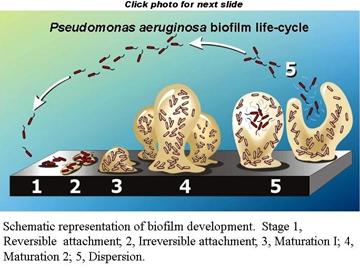
Biofilm formation is
a developmental process in which bacteria undergo a regulated lifestyle switch
from a nomadic unicellular state to a sedentary multicellular state where
subsequent growth results in structured communities and cellular
differentiation. Results of prior work by many groups allow the construction of
a hypothetical developmental model for biofilm formation that can be
generalized for many different bacterial species. This model can be adjusted to
fit either of two general modes of unicellular lifestyle: nonmotile and motile.
Tuesday, March 18, 2014
Unusual Types of Bacteria (Part 3)
. Actinomycetes
Actinomycetes
are gram-positive filamentous bacteria characterized by mycelial growth (i.e.,
branching filaments), which is analogous to fungal growth. However, the diameter
of the filaments is similar in size to bacteria (approximately 1 mm).
Most actinomycetes are strict aerobes, but a few of them require anaerobic
conditions. Most of these microorganisms produce spores, and their taxonomy is
based on these reproductive structures (e.g., single spores in Micromonospora
or chains of spores in Streptomyces).
They are commonly found in water, wastewater treatment plants, and soils (with
preference for neutral and alkaline soils). Some of them (e.g., Streptomyces)
produce a
Saturday, March 15, 2014
Unusual Types of Bacteria (Part 2)
. Gliding
Bacteria
These
filamentous gram-negative bacteria move by gliding, a slow motion on a solid surface.
They resemble certain cyanobacteria except that they are colorless. Beggiatoa
and Thiothrix are gliding bacteria that
oxidize H2S to S0, which accumulates as sulfur granules inside the cells. Thiothrix
filaments are characterized by their ability to form rosettes. Myxobacteria are another group of
gliding microorganisms. They feed by lysing bacterial, fungal, or algal cells.
Vegetative cells aggregate to make “fruiting bodies,” which lead to the
formation of resting structures called myxospores. Under favorable conditions,
myxospores germinate into vegetative cells.
. Bdellovibrio
(B. bacteriovorus)
These
small (0.2–0.3 mm), flagellated (polar
flagellum) bacteria are predatory on gram-negative bacteria. After attaching to
the bacterial prey, Bdellovibrio penetrates the cells
and multiplies in the periplasmic space (space between the cell wall and the plasma
membrane). Because they lyse their prey, they are able to form plaques on a lawn
of the host bacterium. Some Bdellovibrio can
grow independently on complex organic media.
Wednesday, March 12, 2014
Unusual Types of Bacteria (Part 1)
. Sheathed
Bacteria
These
bacteria are filamentous microorganisms surrounded by a tubelike structure called
a sheath. The bacterial cells inside the sheath are gram-negative rods that become
flagellated (swarmer cells) when they leave the sheath. The swarmer cells produce
a new sheath at a relatively rapid rate. They are often found in polluted streams
and in wastewater treatment plants. This group includes three genera: Sphaerotilus, Leptothrix, and Crenothrix.
These bacteria have the ability to oxidize reduced
Subscribe to:
Posts (Atom)