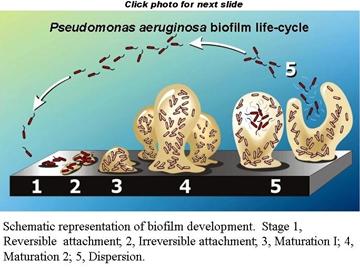
Biofilm formation is
a developmental process in which bacteria undergo a regulated lifestyle switch
from a nomadic unicellular state to a sedentary multicellular state where
subsequent growth results in structured communities and cellular
differentiation. Results of prior work by many groups allow the construction of
a hypothetical developmental model for biofilm formation that can be
generalized for many different bacterial species. This model can be adjusted to
fit either of two general modes of unicellular lifestyle: nonmotile and motile.
Saturday, March 29, 2014
Thursday, March 27, 2014
Transport of an Infectious Agent
Transmission involves
the transport of an infectious agent from the reservoir to the host. It is the
most important link in the chain of infection. Pathogens can be transmitted
from the reservoir to a susceptible host by various routes (Sobsey and Olson,
1983).
a. Person-to-Person
Transmission
The most common route
of transmission of infectious agents is from person to person. The best
examples of direct contact transmission are the sexually transmitted diseases
such as syphilis, gonorrhea, herpes, or acquired immunodeficiency syndrome
(AIDS).
Determination of Cell Biochemicals
Microbial biomass can
also be measured by determination of specific cell biochemical constituents
such as ATP, DNA, RNA, proteins, phospholipids, bacterial cell wall components,
or photosynthetic pigments (Sutton, 2002).
a.
ATP
Adenosine triphosphate
has often been used to determine live microbial biomass in environmental
samples, using a ratio of C/ATP
= 250 for aquatic
samples. However, the ATP content of cells varies with the growth rate and
metabolic state of microorganisms and nutrient limitation. A better measure is
the total
adenylate pool AT
(AT = ATP + ADP + AMP) because it does
not change greatly with changes in metabolic activities of the microorganisms.
The adenylate
energy charge (EC)
ratio provides information on growth potential of naturally occurring microbial
populations.
Tuesday, March 18, 2014
Fungi (Eukaryote)
Fungi are eukaryotic organisms that produce long filaments called hyphae,
which form a mass called mycellium. Chitin is a characteristic component of the
cell wall of hyphae. In most fungi, the hyphae are septate and contain
crosswalls that divide the filament into separate cells containing one nucleus
each. In some others,the hyphae are nonseptate and contain several nuclei. They
are called coenocytic hyphae.
Unusual Types of Bacteria (Part 3)
. Actinomycetes
Actinomycetes
are gram-positive filamentous bacteria characterized by mycelial growth (i.e.,
branching filaments), which is analogous to fungal growth. However, the diameter
of the filaments is similar in size to bacteria (approximately 1 mm).
Most actinomycetes are strict aerobes, but a few of them require anaerobic
conditions. Most of these microorganisms produce spores, and their taxonomy is
based on these reproductive structures (e.g., single spores in Micromonospora
or chains of spores in Streptomyces).
They are commonly found in water, wastewater treatment plants, and soils (with
preference for neutral and alkaline soils). Some of them (e.g., Streptomyces)
produce a
Subscribe to:
Posts (Atom)